



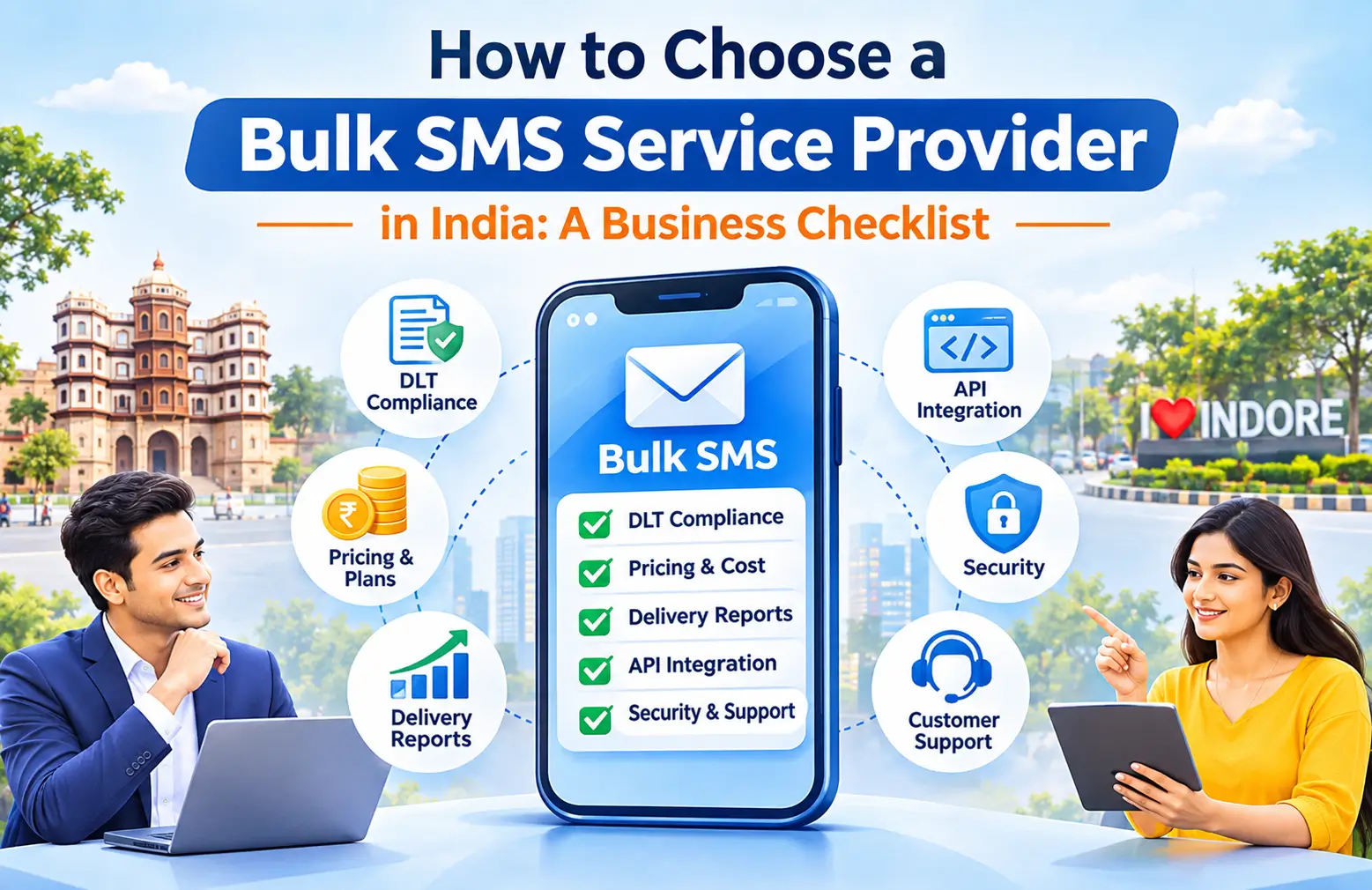
How to Choose a Bulk SMS Service Provider in India: A Business Checklist
Choosing the right bulk SMS service provider in India can make a significant difference to how a business communicates with its customers. Whether you need to send promotional offers, OTPs, payment alerts, appointment reminders, or order updates, the provider you select affects your communication workflow, reporting, compliance, and overall costs.
However, not every SMS platform offers the same features, support, integrations, or pricing structure. A provider that suits a small retail business may not meet the requirements of an e-commerce company, educational institution, or application that sends verification codes.
Before making a decision, businesses should compare more than the price per SMS. They should evaluate message types, DLT compliance support, delivery reports, API integration, scalability, security, and customer assistance.
In this guide, we explain how to choose a bulk SMS service provider in India, which features to check, and what questions to ask before selecting a platform.
What Is a Bulk SMS Service Provider?
A bulk SMS service provider offers a platform that enables businesses to send text messages to multiple recipients through a web dashboard, an API, or another supported integration.
Businesses use these platforms for customer notifications, promotional campaigns, authentication messages, appointment reminders, and other communication requirements. A retailer might send an offer to customers who opted in to receive promotions. An e-commerce business might send order updates, while an application might use OTP SMS for account verification.
If your business needs a local service option, explore our Bulk SMS Service in Indore to understand the available business messaging solution.
10 Things to Check Before Choosing a Bulk SMS Provider
1. Check Whether the Provider Supports Your Message Type
Start by identifying what you want to send. Different business requirements may need different SMS routes, templates, and configurations.
| Message type | Common business use |
|---|---|
| Promotional SMS | Offers, discounts, product announcements, and eligible marketing campaigns |
| Transactional SMS | Relevant transaction notifications and business alerts |
| OTP SMS | Login verification, registration, and authentication |
| Service messages | Eligible customer updates related to an existing service or transaction |
Ask the provider which message categories it supports and what registration, configuration, or eligibility requirements apply to your use case. Do not assume every SMS account can send every message type.
Learn more through our Promotional SMS Service , Transactional SMS Service , and OTP SMS Service pages.
2. Verify DLT Compliance and Registration Support
For businesses sending bulk SMS in India, regulatory compliance is an essential part of provider selection. The Telecom Regulatory Authority of India (TRAI) provides guidance for commercial communications under the Telecom Commercial Communications Customer Preference Regulations, 2018.
Depending on the communication and applicable requirements, businesses may need to complete steps such as:
- Registering as a Principal Entity (PE).
- Registering the appropriate SMS header.
- Registering message content templates.
- Registering consent templates where applicable.
- Obtaining and maintaining required customer consent.
- Following procedures for submitting messages through telecom service providers.
Ask whether the provider helps you understand these requirements and configure your messaging workflow correctly. A useful starting point is the official TRAI Advice to Senders.
Important: A provider's compliance assistance does not automatically make every campaign compliant. Your business must meet the requirements applicable to its messages and audience.
3. Compare Pricing and the Total Cost of Sending SMS
The lowest advertised per-message rate does not necessarily represent the lowest overall cost. Ask providers for a written quotation that explains:
- Price per SMS or applicable pricing unit.
- Available credit packages and validity conditions.
- Whether taxes are included.
- Account setup or activation fees.
- API access or integration charges, if applicable.
- Additional platform or support fees.
- How message segments are counted.
- Credit deductions for different message lengths or encodings.
- Terms for unused credits and refunds.
Compare quotations using the same message volume, message type, destination, and technical requirements. For example, a business sending 50,000 messages per month should compare the total cost for that volume rather than only the advertised starting price.
For an alternative business messaging channel, read our WhatsApp Business API Pricing in India: Complete 2026 Cost Guide . Always request current, written pricing before purchasing a package because rates and commercial terms can change.
4. Evaluate Delivery Reports and Message Tracking
A bulk SMS platform should provide useful information about what happens after a message is submitted. Ask whether it offers delivery reports, message IDs, timestamps, failure statuses, and campaign-level reporting.
These details can help your team investigate delivery problems. If an order notification is not received, your team should be able to check the available report and determine whether the message was accepted, delivered, or reported as failed.
A delivery report does not necessarily confirm that a person read or acted on a message. Delivery status, engagement, and conversion are different measurements. Check whether reports can be exported and whether they meet your team's operational needs.
5. Check API Integration and Developer Support
If you want to send messages automatically from your website, mobile application, CRM, or business software, check the provider's API capabilities. Ask these questions:
- Is API documentation available?
- Which authentication methods are supported?
- Can the API return message IDs and submission statuses?
- Are delivery callbacks or webhooks available?
- Are there rate limits or usage restrictions?
- How are errors and failed requests handled?
- Is a testing environment available?
- What support is available during integration?
An e-commerce website might trigger an order confirmation after checkout. A software application might request an OTP during registration. In both cases, the integration should handle timeouts, duplicate requests, failed submissions, and appropriate retry limits.
Do not assume every provider supports webhooks, every programming language, or every CRM integration. Confirm the exact capabilities before implementation.
6. Check the Dashboard and Ease of Use
A good dashboard should make routine messaging tasks straightforward. During a demonstration, check whether your team can:
- Upload and manage recipient lists.
- Create and manage approved message templates.
- Schedule campaigns where supported.
- Select the appropriate message category.
- Review submission and delivery reports.
- Monitor credit usage and export reports.
- Manage account users and permissions.
A simple interface can reduce training time. Ask for a demonstration or trial if available, and test the workflow your team will use most frequently rather than relying only on screenshots or marketing descriptions.
7. Evaluate Customer Support
Technical problems can affect OTP verification, customer notifications, and scheduled campaigns. Support availability and escalation procedures should be part of your evaluation. Ask the provider:
- What support channels and hours are available?
- Is technical assistance available for API integration?
- How are delivery failures investigated?
- Is there an escalation process for urgent issues?
- Are support response times documented?
If your application depends on verification messages, ask how incidents are handled and how service disruptions are communicated. Do not assume round-the-clock support or guaranteed resolution times unless documented in the service terms.
8. Check Security and Data Protection
Bulk SMS platforms may process phone numbers, message content, customer identifiers, and authentication-related information. Before sharing customer data, understand how the provider handles it.
- Account authentication and access controls.
- Role-based permissions for team members.
- Protection of API credentials.
- Data retention and deletion policies.
- Access to message logs.
- Incident reporting procedures.
- Applicable contractual and privacy obligations.
Never expose API keys in public code repositories or frontend JavaScript. Server-side applications should protect credentials and restrict access to authorised users.
For OTP workflows, avoid logging sensitive authentication information unnecessarily. Use appropriate expiry periods, retry limits, and safeguards against repeated requests. Choose a provider whose security practices and contractual commitments fit your requirements.
9. Check Scalability and Reliability
Your messaging requirements may change as your business grows. Discuss the following with the provider:
- Supported message throughput.
- Account or API rate limits.
- Expected processing and delivery behaviour.
- Campaign scheduling and queue management.
- Capacity during peak periods.
- Incident communication and escalation.
- Documented service availability commitments, if any.
For large campaigns, ask how high-volume submissions are managed. For OTPs or time-sensitive alerts, test the complete workflow under realistic conditions. No provider should be assumed to guarantee delivery to every handset within a fixed time; network conditions, operator processing, and configuration can affect delivery.
10. Review the Provider's Business Experience and Service Fit
The right provider should understand your requirements and explain how its services address them. Review service documentation, support arrangements, integrations, and relevant customer references.
Ask for a demonstration using a representative workflow. For example:
- A school may need attendance alerts and parent notifications.
- A coaching institute may need admission updates and class reminders.
- A retailer may need promotional messages for eligible customers.
- An e-commerce company may need order and payment notifications.
- A software business may need OTP verification and delivery reports.
For education-related requirements, explore Bulk SMS Service in Indore for Schools and Bulk SMS for Coaching Institutes . Select a provider based on verified capabilities, not marketing claims alone.
Bulk SMS Provider Comparison Checklist
Use this checklist when evaluating two or more providers. Record the answers for each vendor before making your final decision.
| Evaluation factor | Questions to ask |
|---|---|
| Message types | Does the provider support my required SMS categories? |
| DLT compliance | What registration and template support is available? |
| Pricing | What is the complete cost for my expected monthly volume? |
| Delivery reports | Can I investigate delivery statuses and failures? |
| API integration | Are the required endpoints, documentation, and callbacks available? |
| Dashboard | Can my team manage campaigns and reports efficiently? |
| Customer support | What channels, hours, and escalation procedures are available? |
| Security | How are credentials, phone numbers, and message logs protected? |
| Scalability | Can the service handle expected and peak traffic? |
| Contract terms | What are the service commitments, credit validity conditions, and exit terms? |
Practical tip: Mark each requirement as Verified , Needs confirmation , or Not supported . Ask the provider to demonstrate important features rather than relying only on verbal assurances.
Common Mistakes to Avoid When Choosing a Bulk SMS Provider
Choosing only by price
A lower rate may not include the features, support, reporting, or integration you need. Compare the total cost and service terms before deciding.
Ignoring compliance requirements
A platform does not remove your responsibility to follow applicable telecom regulations. Verify the registration, template, consent, and message-category requirements for your use case.
Assuming every message will be delivered instantly
Network conditions, operator processing, invalid numbers, and configuration errors can affect delivery. Check reporting and escalation procedures instead of relying on unsupported guarantees.
Selecting an API without testing it
Test authentication, error handling, rate limits, callbacks, and retry behaviour before launch.
Overlooking future requirements
Consider expected growth, reporting needs, security controls, and additional messaging channels before committing to a platform.
Is Bulk SMS Better Than WhatsApp Business API?
Bulk SMS and WhatsApp Business API serve overlapping but different communication needs. SMS can be useful for text-based notifications, verification workflows, and communications that do not depend on an internet messaging application. WhatsApp Business API can support business conversations and richer messaging experiences, subject to its policies and technical requirements.
The right option depends on your audience, use case, budget, consent requirements, and integration needs. Compare our WhatsApp Business API service and WhatsApp Business API Pricing in India . Some businesses may benefit from a combination of channels, evaluated separately for each use case.
Why Consider BulkSMS.bz for Business Messaging?
BulkSMS.bz offers business messaging services for organisations looking to manage customer communications through SMS and related channels. Depending on your requirements, explore these services:
- Bulk SMS Service Provider in Indore for bulk messaging requirements.
- Promotional Bulk SMS Service for eligible promotional campaigns.
- Transactional SMS Service for business notifications.
- OTP SMS Service for authentication-related messaging.
- RCS Messaging Service for rich communication options.
- Voice SMS Service for voice messaging requirements.
- Website Development Services for website development alongside communication needs.
Review the relevant service page and contact the team to confirm current pricing, supported features, integration options, and suitability for your use case.
Frequently Asked Questions
1. How do I choose the best bulk SMS service provider in India?
Identify your message types, compare total pricing, verify DLT compliance support, evaluate delivery reports and API features, and review security and customer support. Test the service before committing to a large campaign.
2. What features should a bulk SMS platform provide?
Depending on your requirements, useful features may include campaign management, contact-list handling, message templates, delivery reports, credit monitoring, API access, scheduling, and exportable reports. Confirm which features are actually included.
3. How much does a bulk SMS service cost in India?
Pricing varies by provider, message category, volume, route, package, and other commercial terms. Request a written quotation that identifies applicable rates, taxes, credit validity, and additional charges.
4. Is DLT registration required for bulk SMS in India?
Businesses sending regulated commercial communications must follow the applicable TRAI framework and telecom service provider procedures. Requirements can include Principal Entity registration, registered headers, content templates, and consent where applicable. Consult the official TRAI Advice to Senders for current guidance.
5. Can I integrate bulk SMS with my website or application?
Many providers offer APIs, but supported features vary. Confirm the documentation, authentication, delivery callbacks, rate limits, and error-handling behaviour before choosing a platform.
6. What is the difference between promotional SMS and transactional SMS?
Promotional messages generally support eligible marketing communication, while transactional messages relate to qualifying transactions and other defined purposes. Classification and permitted use must follow applicable regulatory requirements.
7. How can I check whether my SMS messages are delivered?
Use delivery reports, message IDs, timestamps, and failure statuses where available. These records can help identify delivery issues, but a delivery report does not necessarily prove that a recipient read the message.
8. Can small businesses use bulk SMS services?
Yes. Small businesses can use bulk SMS for suitable customer notifications, promotional campaigns, reminders, and other messaging needs. Compare package terms, costs, compliance requirements, and the features you actually need.
Final Thoughts
Choosing a bulk SMS service provider in India requires more than comparing prices. Businesses should evaluate message categories, regulatory compliance, reporting, API integration, security, customer support, and scalability.
Start by listing your communication requirements. Compare providers using the same criteria, verify important capabilities, and test the complete workflow before making a long-term commitment.
If you are evaluating messaging solutions for your business, explore the BulkSMS.bz Bulk SMS Service and review the available options for your use case.
Leave a Reply
Your email address will not be published. Required fields are marked